.png)

Learn the key differences between Enrolled Nurses (ENs) and Registered Nurses (RNs), including qualifications, responsibilities, career opportunities, and which nursing pathway is right for you.
If you're planning a career in healthcare, you've probably come across the terms Enrolled Nurse (EN) and Registered Nurse (RN). Both roles are essential to Australia's healthcare system, but they differ in qualifications, responsibilities, and career opportunities.
Understanding the difference between enrolled nurse and registered nurse can help you choose the path that best matches your goals. At Heartline Nursing, we support healthcare services across Adelaide and South Australia by providing experienced nursing professionals who deliver compassionate, high-quality care across hospitals, aged care facilities, disability services, and community settings.
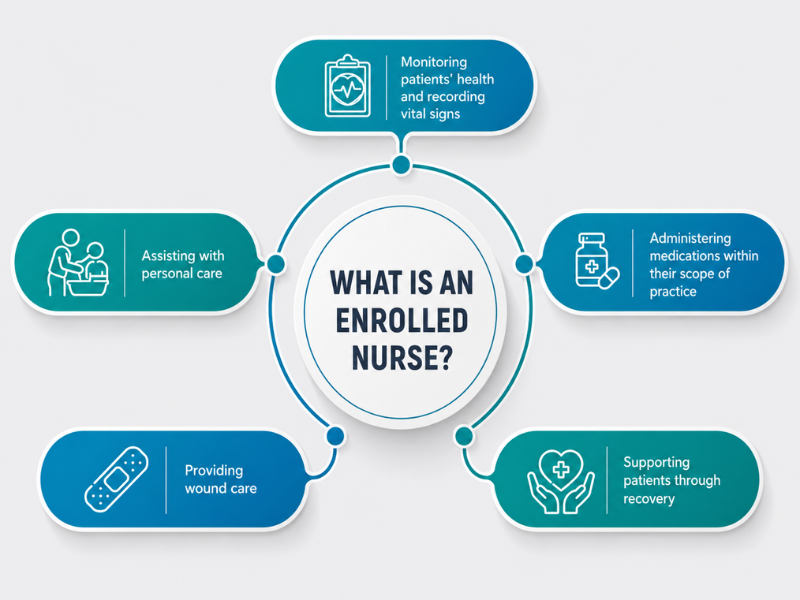
Request Staff NowAn Enrolled Nurse (EN) has completed a Diploma of Nursing and is registered with the Australian Health Practitioner Regulation Agency (AHPRA). ENs work under the direction or supervision of a Registered Nurse while providing direct patient care.
ENs are employed across hospitals, aged care homes, rehabilitation centres, medical clinics, and community healthcare services.
A Registered Nurse (RN) holds a Bachelor of Nursing and is also registered with AHPRA. Compared to an EN, an RN carries a broader scope of practice and greater clinical responsibility.
Registered Nurses assess patients, build nursing care plans, coordinate treatment, supervise Enrolled Nurses, and work closely with doctors and allied health professionals. They also lead patient education and manage more complex clinical situations.
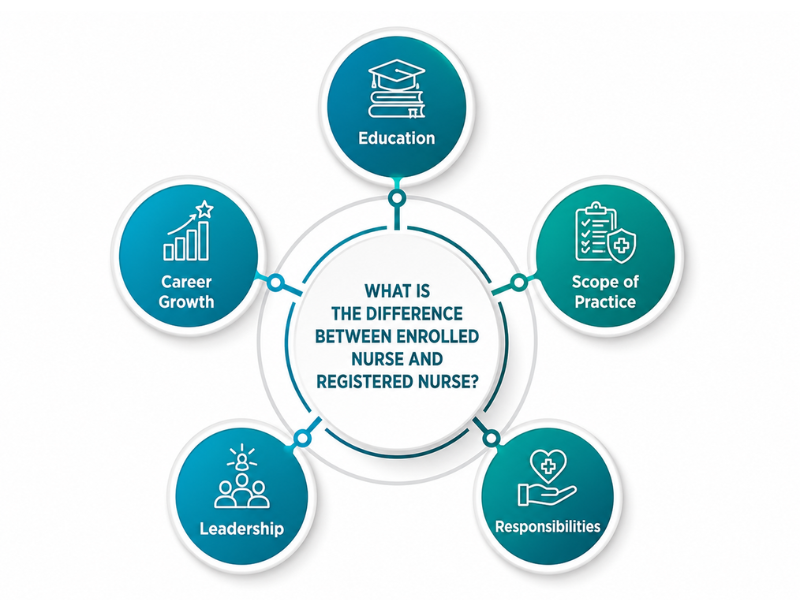
Here's how the two roles compare across the areas that matter most.
Education ENs complete a Diploma of Nursing; RNs complete a Bachelor of Nursing. The university degree gives RNs deeper clinical knowledge and leadership training.
Scope of Practice ENs deliver care under the guidance of an RN. RNs can independently assess patients, develop treatment plans, and make clinical decisions.
Responsibilities ENs focus on hands-on patient care and supporting treatment. RNs oversee that care, coordinate the wider healthcare team, and ensure plans are followed correctly.
Leadership RNs supervise ENs and other care staff, helping maintain consistent standards of care across a ward or facility.
Career Growth RNs have more pathways into specialisation — emergency, ICU, mental health, paediatrics, oncology, surgical nursing — along with leadership, education, and management roles. ENs build valuable hands-on experience and can later bridge into an RN qualification if they choose.
In daily practice, the difference between enrolled and registered nurse becomes clear: an EN monitors a patient's condition, assists with routine care, and reports changes up the chain. An RN performs the deeper clinical assessment, decides on the care plan, and liaises with doctors and therapists to keep that plan on track.
If you want to enter the workforce sooner, the EN pathway gets you there faster. If you're after greater clinical responsibility, leadership opportunities, and room to specialise, the RN qualification is usually the better long-term fit.
At Heartline Nursing , we work with both ENs and RNs across Adelaide and South Australia in hospitals, aged care, disability services, and community healthcare because both roles are essential to good patient outcomes.
Request Staff NowThe difference between an Enrolled Nurse and a Registered Nurse comes down to education, scope of practice, and career progression. ENs provide essential hands-on care under supervision, while RNs take responsibility for assessment, planning, and clinical leadership. Both careers are in high demand across Australia, and either pathway can lead to a rewarding future in nursing.
What is the difference between an enrolled nurse and a registered nurse in Australia?
+The main difference between enrolled nurse and registered nurse is that enrolled nurses complete a Diploma of Nursing and work under the direction of registered nurses, while registered nurses complete a Bachelor of Nursing and have greater responsibility for patient assessment, care planning, and clinical decisions.
Can an enrolled nurse become a registered nurse?
+Yes. An enrolled nurse can complete a Bachelor of Nursing and apply for AHPRA registration as a registered nurse.
How long does it take to become a registered nurse vs enrolled nurse in Australia?
+An enrolled nurse usually completes a Diploma of Nursing in around 18 to 24 months. Becoming a registered nurse generally requires a three-year Bachelor of Nursing.
Do enrolled nurses need AHPRA registration?
+Yes. Enrolled nurses must be registered with the Australian Health Practitioner Regulation Agency (AHPRA) before practising in Australia.
What tasks can an enrolled nurse perform that a registered nurse cannot, and vice versa?
+Enrolled nurses provide direct patient care, administer medications within their scope, and monitor patients. Registered nurses assess patients, develop care plans, supervise staff, and make clinical decisions.
Can enrolled nurses administer medication in Australia?
+Yes. Enrolled nurses can administer medication if they have completed the required training and work within their approved scope of practice.
What is the salary difference between an enrolled nurse and a registered nurse?
+Registered nurses generally earn higher salaries because they have greater responsibilities, higher qualifications, and broader career opportunities.
Who has more responsibility — an enrolled nurse or a registered nurse?
+Registered nurses have more responsibility as they lead patient care, supervise nursing teams, and make important clinical decisions.
How long does it take to become an enrolled nurse in Australia?
+Most Diploma of Nursing programs take approximately 18 to 24 months to complete, depending on the study mode.
Which nursing path is right for me — enrolled nurse or registered nurse?
+If you want to start working sooner, becoming an enrolled nurse is a good option. If you are looking for leadership roles, advanced practice, and wider career opportunities, becoming a registered nurse may be the better choice.